
DO I HAVE CATARACT?
Mr John Mukete is a 65 year’s old retired, railway engineer. He loves spending time reading journals, watching news and documentaries on TV. He also loves driving around town in the evening.
Mr. JM has noticed a change in his vision compared to a year ago. The glasses he bought 6months ago are no longer helping him to read, his distance vision is blurred. He barely recognizes faces on TV. He has increasing difficulty to drive at night. Incoming cars headlights are blinding and increasingly uncomfortable at night .He is wondering if he is developing cataract.
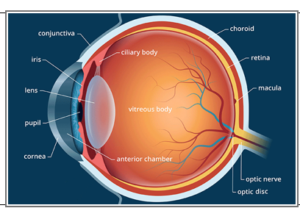
The eye has two “windows “(the cornea and the crystalline lens ) that are clear and transparent , which allow the entry of light in the eye and focus light and images on the retina .
 |
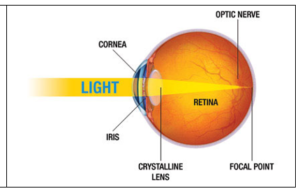 |
Fig 1. Normal eye
Cataract is the clouding of the eye’s natural lens.It disturbs and even blocks the entry of light in the eye contributing to visual impairment and in advanced cases blindness.
According to WHO Stats 2025/2026 ,cataract-related vision impairment affects more than 94 millions people globally .Cataract is the leading cause of blindness in the world, responsible for nearly 17million (39%) of the 43 million cases of blindness.
Cataract is the most prevalent cause of blindness in Cameroon.(Njoya)
CAUSES AND RISK FACTORS OF CATARACT
- Ageing: This is the most common cause. There is degeneration of the natural lens overtime especially after age 50. Cataract related visual impairment increases with age. Need for cataract treatment is common within 65 to 75yrs old.
- Disease conditions: Diabetes and intra ocular inflammations put the lens at risk of degradation and clouding.
- Genetics: Family history and genetics increase the risk of developing cataract at a young age.
- Lifestyle: Excessive alcohol consumption, smoking and prolonged exposure to UV radiation exposes to the risk of developing cataract.
- Medication: prolonged and indiscriminate use of steroids (ie :prednisolone , dexamethasone )increases risk of developing cataract.
- Ocular trauma: ( fist blow, ball hitting the eyr )
Injury damages lens tissue with risk of cataract formation.
- Household air pollution: The use of Biomass (wood, dung, crop residues) for indoor cooking exposes women to a higher risk of developing cataract.
Although cataract affects mainly older patients, it can be seen at any age, even in babies.
SYMTOMS OF CATARACT
An eye developing cataract is not painful or red. The signs and symptoms appear gradually.
The symptoms associated with the onset or presence of cataract are :
- Blurry or cloudy vision,
- Glare or halos: You are very sensitive to bright lights and you see colors around lights
- Faded colors; they do not appear bright. White can look yellow or brown
- Poor vision at night due to increased glare from car headlamps.
- Frequent glasses prescription changes: You need to change power of glasses more often than is needed.
- Seeing double vision or ghost images in one eye
- Second sight: Sometimes, your near vision may improve without glasses.
- Grey or white color change of the window (pupil) of the eye depending on the severity of the cataract.
DIAGNOSIS OF CATARACT
The diagnosis of cataract requires a complete eye consultation in an eye clinic. Full dilation of the pupil could be required.
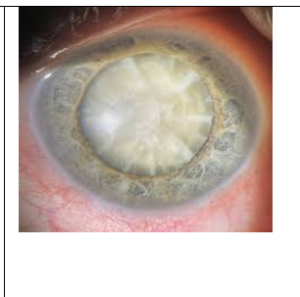
When the disease is established , one can see a grey/ white pupil (leukoria)
Often the doctor uses a light source to examine the eye and confirm the presence of the disease.
NOTA BENE :In small children , do not delay the evaluation because a white pupil can bear a more sinister diagnosis and require immediate care .
Besides diagnosing cataract, the doctor evaluates the impact of the cataract in order to plan the management according to the expectations or needs of the patient
|
|
 |
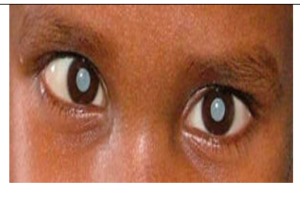 |
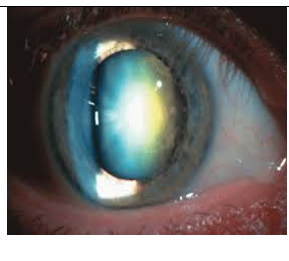
Fig2 : cataract , child with cataract
MANAGEMENT OF CATARACT
The management of cataract will depend on how the vision is affected. There is non-surgical management for minor visual loss
and surgical management when quality of life is affected and curative treatment is required .
- Non-Surgical Management : while waiting for the surgery
This involves the use of conservative measures when quality of life is not yet significantly affected.
- Updated prescriptions: Changing spectacle prescriptions could compensate for refractive changes due to early cataract: This is usually a temporary fix.
- Lifestyle adjustments: Minimizing night time driving; using brighter lights for reading.
- Glare reduction: Wear hats with broad brim and anti-glare or polarized glasses to reduce sunlight exposure ,light sensitivity and discomfort.
- Surgical management: currently the only one that removes the cataract
Surgery is recommended when the cataract significantly hampers activities of daily living like reading, driving, watching TV.
It involves removing the cloudy, opaque natural lens in the eye and replacing with a clear, transparent artificial lens. It is a relatively short (15-30min) surgical procedure done under local anesthesia.
In some cases, patient cooperation with local anesthesia cannot be guaranteed – general sedation can be suggested to facilitate the procedure especially in children.
WHERE TO FIND HELP
Consult an ophthalmologist who will assess with you the best options of management depending of your expectations or needs.
CONCLUSION
Mr JM should consult an ophthalmologist who will confirm the presence of the disease. He will discuss and evaluate the contribution of the cataract to his visual disturbances and difficulty to perform daily tasks.
A management option will be chosen based on the immediate needs, expectations and possible outcome of the surgical management at the given time.
Cataract is a common blinding disease. Its treatment is surgical. In children, its management should not be delay as it may compromise permanently the visual development of the child.
Mr TONTU ZIK
Ophthalmic clinical officer
Mboppi Baptist Hospital
Supervision Dr E.Kamdem
REFERENCES
1-https://www.who.int/news-room/fact-sheets/detail/blindness-and-visual-impairmen
- Thulasiraj D. Ravilla, Sanjeev Gupta, Ravilla D. Ravindran, Praveen Vashist, Tiruvengada Krishnan, Giovanni Maraini, UshaChakravarthy, Astrid E. Fletcher. Use of cooking fuels and cataract in a population based study: the India Eye Disease Study. Environmental Health Perspectives. DOI: 10.1289/EHP193.
- https://archive.cehjournal.org/article/recognising-and-managing-bilateral-cataracts-in-children/
0 commentaires